
Traditional Catholic Rosary Beads
Traditional Catholic Rosary Beads are more than a devotional item. They are a simple way to hold prayer in your hands, to mark time with God in the middle of ordinary days, and to stay rooted in faith when life feels noisy or uncertain.
On this page you will find a gentle, practical guide on how different styles of rosaries can support your own rhythm of prayer at home, at work, or on the road. Nothing here is about collecting religious objects. It is about finding one set of beads you can actually live with and pray with, quietly, for years.

Why traditional rosary beads still matter today
Many Catholics in the United States grew up seeing a rosary hanging from a rearview mirror, tucked into a grandmother’s purse, or folded quietly between the hands of someone in a hospital bed. Even if we did not always understand every prayer, the sight of the beads meant something calm and steady. It was a reminder that faith could be carried into everyday life without a lot of words.
In my own life, there have been seasons when my rosary gathered dust in a drawer, and others when it became the first thing I reached for in the morning. I remember one stressful year at work when I started praying just one decade in the car before stepping into the office. My traditional Catholic rosary beads were nothing fancy, but the weight of them in my hand helped me breathe a little more slowly and remember I was not alone.
The heart of the rosary is simple: we repeat familiar prayers while thinking quietly about the life of Jesus. The beads do not “do” anything by themselves. They simply keep our fingers moving so our minds can rest in prayer. That is why the quality, texture, and style of the beads can matter more than we expect. The right pair for you is one you are not afraid to handle daily, to tuck into a pocket, to bring to adoration, or to hold in the quiet before bed.
If you have not prayed the rosary in a long time, or if you have never had your own set of beads, there is no pressure here. You can begin very small: a decade during a walk, a few Hail Marys while waiting in a parking lot, or a slow rosary on Sunday evening. The beads are simply there to help your hands follow along.
Things to consider when choosing rosary beads
- Material in your hand: Some people prefer the cool feel of metal or glass, while others like the warmth of wood or olive wood.
- Durability for daily use: If you keep a rosary in your bag or pocket, a stronger chain or cord can be helpful.
- Visibility and size: Larger beads are easier to feel in the dark or for older hands; smaller ones slip easily into a pocket.
- Quiet design: Simple, traditional designs tend to age well and feel at home in any setting.
- Connection: Some people like rosaries with a particular saint medal or a specific crucifix that quietly reminds them of a personal story.
The goal is not perfection or beauty for its own sake, but choosing something that gently invites you back to prayer, again and again.
Different styles of traditional Catholic rosary beads
Across centuries, Catholics have prayed with many forms of rosaries. While the basic structure is usually the same, details can vary: number of beads, materials, medals, or crucifix style. These choices do not change the heart of the prayer, but they can shape how the rosary fits into your daily life.
Some people feel drawn to more elaborate rosaries, with detailed metalwork or colored stones. Others prefer a plain wooden rosary that feels almost invisible. Personally, I have gone through phases. In college, I carried a simple black cord rosary that never tangled. Later, I was given a heavier metal rosary that I keep by my bedside; it is not ideal for travel, but it feels solid and steady in my hands during late-night prayer.
If you are curious about the history behind the devotion, you might appreciate reading about the rosary tradition itself. Learning how generations before us prayed with beads can make our own practice feel less lonely. We are not inventing something new; we are joining a long, quiet line of believers.
Wooden rosary beads
Wooden rosaries are among the most familiar and accessible. The texture of wood is gentle and usually warms quickly to the touch. For many of us, a wooden rosary brings to mind grandparents or parish gift shops, the kind of rosary that simply exists in the background of Catholic life.
One of my earliest memories of prayer involves sitting near my grandmother as she moved her fingers along smooth dark wooden beads. She did not say much. She would simply begin, almost under her breath, and I would hear the quiet rhythm of Hail Mary after Hail Mary. Those beads were worn from use, not from being stored away.
Wooden traditional Catholic rosary beads are usually light, so they are comfortable for longer prayers. They are also less likely to clink loudly, which can be helpful if you pray in a chapel, at night while others are sleeping, or during adoration.

Metal and stone rosary beads
Metal or stone rosaries tend to feel heavier and cooler in the hand. Some people find that this weight helps them stay grounded and focused. Others like the sense of stability that comes with a more substantial rosary, especially when praying during stressful times.
I keep a metal rosary on my nightstand that was given to me during a difficult year. There were many nights when I could not find the right words to pray. On those nights, I would simply hold the crucifix or move my fingers slowly from bead to bead, allowing the familiar prayers to carry me when my mind was tired. The rosary did not “fix” anything, but it gave me a way to stay turned toward God instead of shutting down completely.
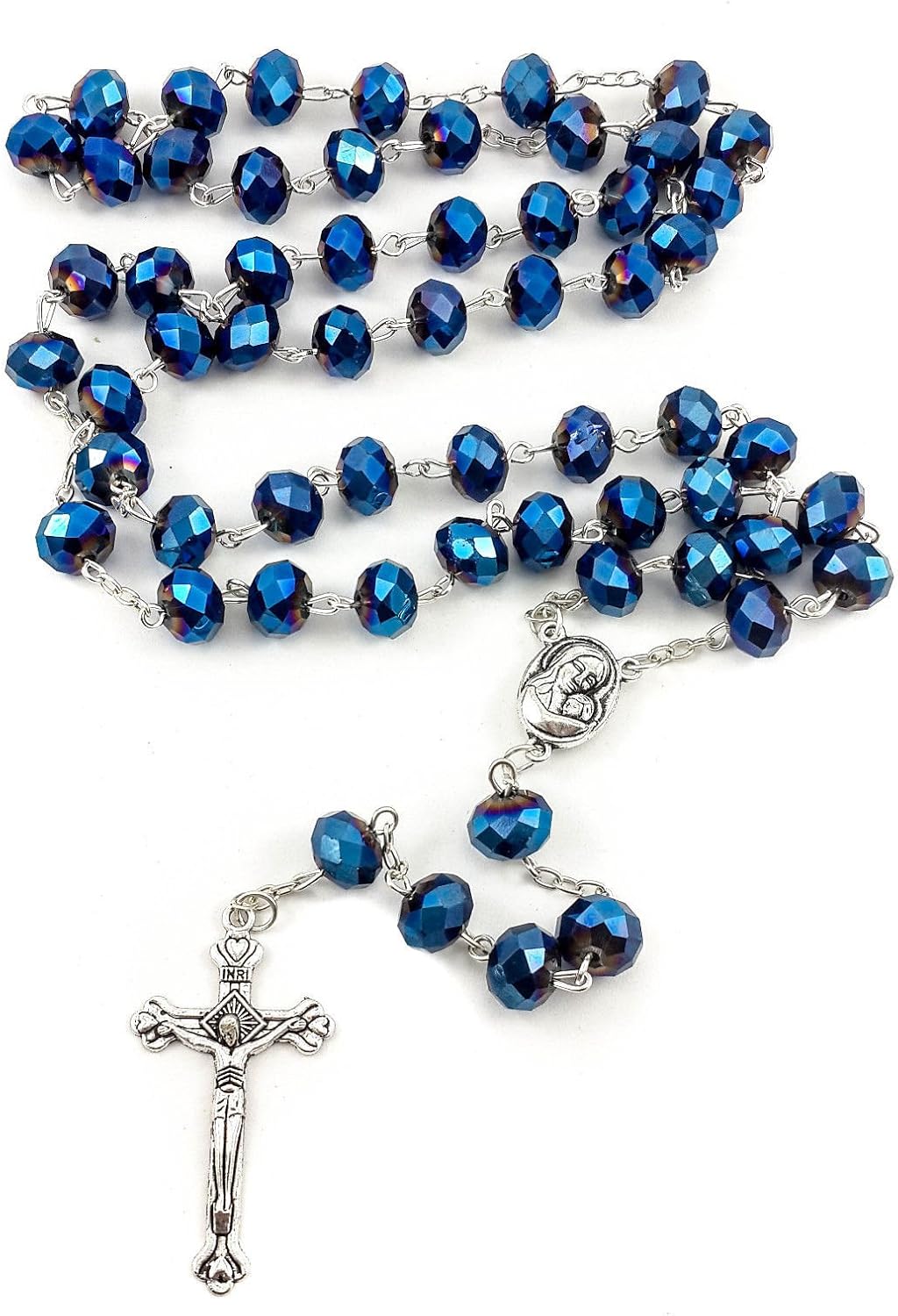
Stone beads, such as howlite, jasper, or glass imitations of precious stones, offer a different kind of presence. Their cool surface can be calming. The muted colors often blend naturally into daily life, making the rosary feel like something you can carry without drawing attention to yourself.

Corded and pocket rosaries
For people often on the go, corded rosaries and pocket rosaries can make it much easier to keep prayer close. Corded rosaries are usually made with paracord or strong thread, with knots or beads that can handle daily wear. Pocket rosaries, whether a full set of five decades or a smaller one-decade ring, are easy to keep in a wallet, backpack, or desk drawer.
There was a season when I prayed most often in parking lots. Between errands, before going into work, waiting to pick up a family member—I would pull out a small pocket rosary from the side compartment of my car and quietly pray a decade. No one else needed to know. The simplicity of that one-decade rosary made it feel possible, even on days when I felt scattered and hurried.
If you travel frequently or find yourself often between places, keeping a small, sturdy set of traditional Catholic rosary beads in the car or in your bag can gently remind you that every in-between moment can become a place of prayer.
How to use traditional Catholic rosary beads in everyday life
It can be easy to imagine that the rosary belongs only in churches, at funerals, or in very devout families. But many Catholics pray in simpler ways: sitting in a comfortable chair after dinner, walking around the block, or resting at the end of the day. The beads are not there to impress anyone. They are there to give your hands something steady while your heart reaches out to God.
One helpful approach is to connect your traditional Catholic rosary beads to an existing routine. For example, you might pray one decade when you first sit in the car, or during a short walk after lunch, or right before turning off the light at night. Over time, the beads will begin to feel like part of that familiar pattern.
I have found that leaving a rosary where I can see it makes a real difference. When mine is tucked away, I forget. When it rests on my dresser, on my desk, or near the TV remote, it gently reminds me that prayer is always possible, even in small pieces. Some evenings, instead of scrolling on my phone, I will pick up the rosary and slowly pray just a few Hail Marys. It is not dramatic, but that small shift often leaves me calmer and more grounded.
The rosary can also be a quiet companion during waiting times: doctor’s offices, long lines, or the sleepless hours of the night. It is comforting to have something physical to hold when words feel out of reach. You do not have to complete all five decades to make it “count.” Even one decade, prayed honestly, is real prayer.

Praying as a family
Many American Catholic families feel a desire to pray together but are not sure where to begin. A full family rosary can feel intimidating, especially with young children or busy schedules. Having simple, sturdy rosary beads available for everyone can make this feel more natural.
Some families start with one decade after dinner or before bedtime. Children often like having their own smaller rosaries, especially colorful ones or those with larger beads that are easier to handle. The goal is not perfect silence or perfect attention, but gently introducing the habit of turning to God together.
In my own home, there were evenings when our attempt at a family decade felt messy and distracted. Yet, over time, those imperfect moments added up. The sight of rosary beads on the coffee table became normal. Even when we did not manage to pray together, the simple presence of the beads reminded us of what we were trying to build.
Caring for your rosary beads
Because rosaries are meant to be used, not displayed, they will naturally show signs of wear over time. Beads may darken from the oils in your hands, metal may soften at the edges, and cords may fray. None of this is a failure; in some ways, it can be a quiet testimony to the prayers carried on those beads.
Still, it is wise to care for your rosary so it can serve you for many years:
- Keep it in a small pouch or case if you carry it in a bag or pocket with keys and coins.
- Avoid leaving wooden or stone beads in direct sunlight or extreme heat, such as on a car dashboard.
- Gently wipe metal or stone beads with a soft cloth from time to time.
- If a cord starts to wear out, consider repairing or replacing the rosary before it breaks completely.
Some Catholics keep more than one set of traditional Catholic rosary beads: one for everyday use and another more delicate one for special occasions. Others simply accept the signs of wear as part of the story of their prayer life.
When and how to replace a rosary
Because rosaries are often given as gifts for sacraments or milestones, it can sometimes feel hard to replace one that has broken or worn out. There is no single “right” way to do this. Some people keep the broken rosary in a small box or drawer as a reminder of the person who gave it. Others repair it if possible, or respectfully bury or dispose of it if it can no longer be used.
When my first adult rosary finally broke—the chain snapped after years of being tossed into bags and glove compartments—I hesitated to replace it. It had been with me during many quiet late-night prayers and long drives. In the end, I chose a new set of beads that was simple but a little stronger. The memory of the old rosary stayed with me, but the new one helped me continue the habit of prayer instead of stopping altogether.
If your rosary has become difficult to use because it tangles easily, breaks repeatedly, or no longer feels sturdy in your hands, it may be time to consider another set of traditional Catholic rosary beads that can better support the way you actually pray.

Making space for quiet: a personal note
One thing I have learned over the years is that prayer with the rosary is rarely dramatic. Most of the time, it looks very ordinary: a few minutes on the couch after a long day, a quiet pause in the car, a walk around the neighborhood with beads in hand or in a pocket. There are no bright lights or big feelings, just the steady rhythm of familiar prayers.
My own relationship with traditional Catholic rosary beads has changed with different seasons of life. There were years when I almost never picked them up. There were other times when my fingers automatically reached for them as soon as I sat down. Through it all, the rosary has been a gentle companion—never forcing itself into my schedule, but always available when I was ready to turn toward God again, even in a small way.
If you feel drawn to return to the rosary or to begin for the first time, know that you do not have to do it perfectly. You can start where you are: one decade, even just a few Hail Marys, whispered while your fingers move along the beads. With time, the beads themselves may begin to feel like an old friend.

Questions about traditional Catholic rosary beads
Do rosary beads have to be blessed?
Rosary beads do not have to be blessed in order for you to pray with them. You can begin praying with any set of beads right away. Many Catholics do like to ask a priest or deacon to bless their rosary when the opportunity arises, but it is not a requirement. If you receive a new set of traditional Catholic rosary beads, you can simply start using them, and seek a blessing later if and when it is convenient.
Is it okay to wear a rosary around my neck?
This is a question many Catholics ask. The key point is respect. The rosary is primarily meant for prayer, not as a decoration. Some people wear a rosary briefly when they have no pockets and want to keep it close for prayer. Others prefer to keep it in a pocket, purse, or pouch. If wearing a rosary helps you remember to pray and you treat it with reverence, that may be appropriate in your situation. If it starts to feel more like jewelry than a prayer tool, it might be better to keep it tucked away.
How do I start praying the rosary if I do not remember all the prayers?
Many of us forget the exact order or words, especially if it has been a long time. You can keep a simple printed guide or a small card in the same pouch as your rosary. There are also many trustworthy parish or diocesan websites that offer step-by-step instructions. When I returned to praying with traditional Catholic rosary beads after years away, I quietly followed a printed guide until the rhythm returned. There is nothing embarrassing about looking at the instructions; what matters is the desire to pray.
Can children use the same kind of rosary beads as adults?
Children can certainly use the same kind of rosaries as adults, but it can be helpful to choose beads that fit their hands and their stage of life. Slightly larger, colorful, or more durable rosaries can work well for kids. Some families keep a small basket of sturdy traditional Catholic rosary beads in the living room so everyone can reach for one when it is time to pray a decade together. The important thing is that the rosary feels approachable, not fragile or off-limits.
What if I feel distracted or restless while praying the rosary?
Distraction is very common, and it does not mean your prayer “doesn’t count.” The beads are there to help gently bring your focus back. If your mind wanders, you can simply notice it and return to the next bead, the next Hail Mary, without getting upset. Sometimes I pray the rosary in a very imperfect way, with my thoughts jumping from concern to concern. Even then, holding the beads reminds me that I am at least trying to stay before God with whatever is on my heart.